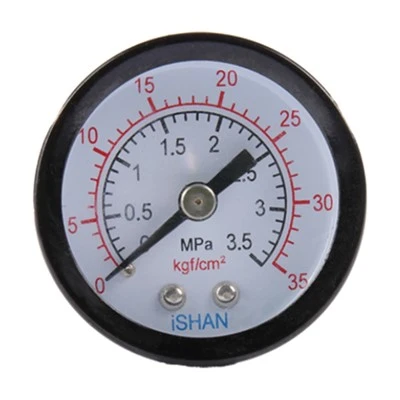
Designed for demanding hydraulic and lubrication systems, the Hydraulic Lubrication Pressure Gauge delivers precise, real-time monitoring. Built to withstand high vibrations and pressure spikes, it prevents equipment failure and maximizes uptime.
Technical Specifications
|
Technical Parameter |
Specification Details |
|
Pressure Range |
0–10 / 16 / 25 / 40 / 60 / 100 / 160 / 250 / 400 / 600 bar (Dual scale PSI/MPa available) |
|
Dial Size Options |
40 mm (1.5"), 50 mm (2"), 63 mm (2.5"), 80 mm (3"), 100 mm (4"), 115 mm, 150 mm (6") |
|
Accuracy Class |
Class 1.0 (±1.0% FS), Class 1.6 (±1.6% FS), or Class 2.5 (±2.5% FS) per EN 837-1 |
|
Process Connection |
G1/8, G1/4, G3/8, G1/2; 1/8" NPT, 1/4" NPT, 3/8" NPT, 1/2" NPT; BSP, BSPT, and SAE threads |
|
Mounting Configuration |
Bottom mount, Lower back mount, Center back mount, Panel mount (front flange), Surface mount |
|
Wetted Materials |
Brass, Copper alloy, or SS316 Stainless Steel (Socket & Bourdon tube) |
|
Case & Bezel Material |
304 Stainless Steel, Black Steel, or Chrome-plated brass |
|
Internal Movement |
Precision Brass or Stainless Steel wear-resistant mechanism |
|
Window / Lens |
Instrument glass, Laminated safety glass, or Polycarbonate |
|
Damping / Filling Liquid |
Pure Glycerin (standard), Silicone oil (optional for low temperatures) |
|
Operating Temperature |
Ambient: -20°C to +60°C; Medium (Process): Up to +100°C (+60°C for glycerin filled) |
|
Ingress Protection |
IP65 (standard dust-tight and water-jet resistant) / IP67 available |
|
Temperature Compensation |
Built-in bimetallic link or thermal error minimization design |
Key Features
High-Pressure Resilience: Built to withstand severe pressure surges and cyclic fatigue in heavy-duty machinery.
Vibration & Pulsation Dampening: Liquid-filled design eliminates pointer flutter for stable, highly readable measurements.
Corrosion-Resistant Media Contact: Premium wetted parts compatible with a wide range of synthetic and mineral-based hydraulic oils.
Rapid Diagnostics: Provides instant visual feedback to detect line blockages, pump wear, or filter clogs before catastrophic failures occur.
Liquid Filled / Damped Design
Glycerin Filling Standard: Factory-filled with high-purity glycerin to dampen severe mechanical vibrations, water hammer, and pressure oscillations, keeping the pointer rock-steady.
Silicone Oil Alternatives: Available with high-temperature or low-temperature silicone oil fills for extreme operational environments ranging from sub-zero outdoor yards to hot industrial foundries.
Extended Internal Life: Viscous damping fluid continuously lubricates internal movement gears and pivots, virtually eliminating premature wear and tear.
Pressure Equalization Venting: Features an integrated rubber fill plug or pressure relief vent to prevent case over-pressurization caused by internal thermal expansion.
Accuracy & Reliability
Strict Calibration Standards: Every accurate hydraulic pressure gauge is multi-point calibrated using state-of-the-art dead-weight testers to ensure EN 837-1 compliance.
Low Hysteresis Performance: High-grade elastic materials ensure the pointer returns precisely to zero after repeated pressure loading and unloading cycles.
Overpressure Tolerance: Designed to safely withstand temporary overpressure spikes up to 130% of the maximum scale rating without permanent calibration shift.
Long-Term Stability: Resilient internal linkages prevent drift over extended operational lifespans, minimizing the need for frequent field adjustments.
Maintenance
Routine Visual Inspection: Regularly check for external oil leaks, cracked windows, bent pointers, or excessive casing corrosion.
Zero-Point Verification: Periodically inspect the gauge when the system is fully depressurized to ensure the pointer rests squarely at the zero stop pin.
Annual Calibration Cycle: Implement a 12-month recalibration schedule using certified reference standards to maintain quality management compliance.
Replacement Protocol: Immediately replace any gauge exhibiting sluggish pointer movement, internal fluid discoloration, or permanent calibration drift.
Frequently Asked Questions
Hot Tags: hydraulic lubrication pressure gauge, China hydraulic lubrication pressure gauge manufacturers, suppliers, factory