

Industrial Lubrication Fittings for Reliable Connection, Lubricant Delivery & Pressure Monitoring
Lubrication fittings are essential components in centralized and manual lubrication systems. They provide the connection between lubrication pumps, tubing, hoses, distributors, metering devices and lubrication points, while related pressure instruments help maintenance teams monitor system operating conditions.
-
![Industrial Centralized Lubrication System Oil Filter]() Industrial Centralized Lubrication System Oil FilterThe Industrial Centralized Lubrication System Oil Filter is a filtration component designed to remove solid contaminants from lubricating oil before it enters pumps, distributors, metering...
-
![Pump Lube Oil System]() Pump Lube Oil SystemThe Pump Lube Oil System is a fully integrated, skid-mounted auxiliary unit designed to deliver a continuous, temperature-controlled, and highly filtered supply of pressurized lubricating oil to...
-
![Lubrication Pump Joint]() Lubrication Pump JointOur Lubrication Pump Joint is a precision-engineered fitting that connects pumps, distributors, and lines, preventing leaks and blowouts to ensure reliable performance in harsh industrial machinery.
-
![Grease Fitting Joint]() Grease Fitting JointOur high-pressure grease fitting joint ensures secure, leak-proof connections between lubrication pumps, supply lines, and bearings, delivering reliable grease delivery under rigorous industrial...
-
![Grease Nipple Joint]() Grease Nipple JointOur high-pressure grease nipple joint bridges automatic lubrication pumps with distributed bearing points, establishing a secure, metal-to-metal seal that handles rigorous industrial duty cycles...
-
![Lubrication Fittings Quick Coupling]() Lubrication Fittings Quick CouplingPrecision-engineered Lubrication Fittings Quick Couplings provide seamless connectivity between grease guns and fittings. Designed for heavy-duty machinery, they ensure rapid, leak-resistant...
-
![Quick Disconnect Joint]() Quick Disconnect JointOur high-pressure quick disconnect joint provides an instant, leak-free mechanical link between centralized lubrication pumps and distribution lines. It enables rapid tool-free coupling,...
-
![Lubrication Fittings Hydraulic Joint]() Lubrication Fittings Hydraulic JointOur precision-engineered Lubrication Fittings Hydraulic Joints provide secure, high-pressure connections for centralized systems and heavy machinery. Built to prevent leaks and withstand extreme...
-
![Lubrication Pump Pipe]() Lubrication Pump PipeThe Lubrication Pump Pipe is a tubing component used to transfer grease or lubricating oil from a lubrication pump to distribution components and lubrication points. It is designed for centralized...
-
![Liquid Filled Lubrication Pressure Gauge]() Liquid Filled Lubrication Pressure GaugeDesigned for severe industrial environments, our Liquid Filled Lubrication Pressure Gauge dampens severe vibration and pulsation to ensure stable, highly accurate pressure readings, extending...
-
![Hydraulic Lubrication Pressure Gauge]() Hydraulic Lubrication Pressure GaugeDesigned for demanding hydraulic and lubrication systems, the Hydraulic Lubrication Pressure Gauge delivers precise, real-time monitoring. Built to withstand high vibrations and pressure spikes,...


Why Lubrication Fittings Matter
A lubrication system can contain dozens or even hundreds of individual connection points. A pump may generate the required pressure, but the lubricant still has to pass through a network of:
Pump → Main Line → Distributor → Branch Line → Fitting → Lubrication Point.
Every connection is therefore part of the overall lubrication circuit.
An unsuitable fitting can result in:
Lubricant leakage, pressure loss, incorrect connection, difficult maintenance, contamination entering the circuit, premature component replacement, and installation delays.
For this reason, fitting selection should be based on the complete technical specification, not simply the external appearance of the component.
Key Lubrication Fitting Types
Grease Fittings: Provide an access point for injecting grease into bearings, bushings, pins, joints, and other lubricated components. Commonly used in both manual and centralized grease lubrication applications. Different configurations may be required depending on equipment design.
Lubrication Joints: Connect different components of an oil or grease lubrication circuit. They can be used between pumps and main lines, main lines and distributors, distributors and branch lines, tubing and lubrication points, and grease guns and grease fittings. The correct joint must match connection type, thread, tubing, pressure, and lubricant.
Quick Couplings: Provide a convenient connection and disconnection method for lubrication lines. Useful for equipment requiring frequent maintenance, fast component replacement, modular lubrication connections, easy line disconnection, and service access.
Quick Disconnect Joints: Designed for applications where lubrication lines need to be separated without permanently removing the entire connection assembly. They help simplify maintenance and equipment servicing.
Lubrication Pressure Gauges: Provide visual indication of lubrication system pressure. Help operators and maintenance personnel identify insufficient pressure, excessive pressure, pressure fluctuations, potential blockage, and abnormal system operation. Gauge range and connection specification should be selected according to the actual lubrication system.
How to Select the Right Lubrication Fitting
Confirm the Connection Type: Determine what the fitting needs to connect: pump, tube, hose, distributor, metering device, grease gun, machine lubrication point, or pressure gauge.
Check the Thread Specification: Thread compatibility is one of the most important criteria. Confirm thread standard, thread size, male/female thread, straight or tapered thread, and thread length where applicable. A fitting that looks similar may still be mechanically incompatible.
Check Tube or Hose Size: The fitting must match the connected tubing or hose. Provide tube outside diameter, hose size, connection type, and required fitting configuration.
Identify the Lubricant: Confirm whether the system uses lubricating oil, grease, or other approved industrial lubricant. Lubricant viscosity and compatibility can affect fitting selection and lubricant flow.
Confirm Working Pressure: The fitting must be suitable for the system's operating pressure—especially important for high-pressure grease systems, long lubrication lines, heavy machinery, and centralized automatic lubrication systems.
Consider Installation Space: For confined machinery, fitting geometry can be as important as thread size. Consider straight, 45°, 90°, compact, quick-connect, or extended configurations as needed.
Consider the Environment: The fitting should match the operating environment—temperature, moisture, dust, vibration, outdoor exposure, chemical exposure, wash-down conditions, and corrosive environments.
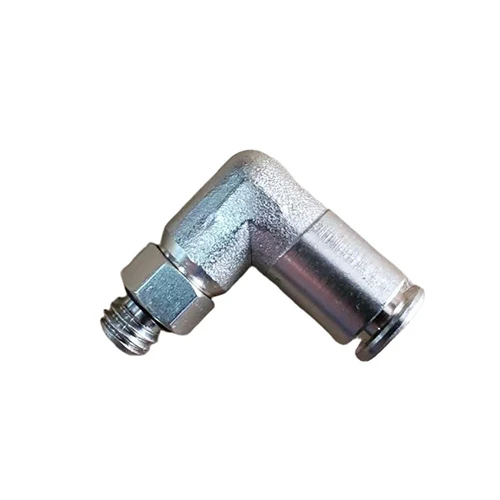
Materials & Surface Options
Carbon Steel
Provides good mechanical strength and is suitable for many general industrial and heavy-duty applications. Where applicable, surface treatment can improve corrosion resistance. Suitable for industrial machinery, construction equipment, heavy equipment, and general centralized lubrication systems.
Stainless Steel
Provides higher corrosion resistance and is suitable for demanding environments. Typical applications include moist environments, outdoor equipment, wash-down areas, marine-related applications, and chemical-exposure environments. The appropriate stainless steel grade should be confirmed according to the application.
Brass
Provides good corrosion resistance and is suitable for selected light- and medium-duty lubrication applications. It also offers good machinability and installation characteristics.
Lubrication Fitting Components
Fitting Body
The main structural component providing the connection between the lubrication equipment and the lubrication point.
Thread
The threaded section secures the fitting to the corresponding machine interface.
Internal Passage
The internal channel allows lubricant to travel through the fitting.
Ball / Check Valve
On applicable grease fittings, the internal ball functions as a check valve, allowing lubricant to enter while helping prevent contaminants and lubricant backflow.
Spring
The spring returns the check valve to its closed position after lubricant pressure is released.
Sealing Element
Depending on the fitting design, sealing components help reduce lubricant leakage and protect the connection from contamination.
Lubrication Fittings for Different Industries
Industrial Machinery: Used on machine tools, production machinery, conveyors, packaging equipment, processing equipment, and automated machinery. Typical lubrication points include pins, bushings, bearings, joints, and moving assemblies.
Construction Equipment: Lubrication fittings are used on pins, bushings, bearings, joints, and moving assemblies in construction machinery.
Mining & Heavy Equipment: Fittings and connection components are used in centralized grease systems serving heavy-duty machinery operating under high load, vibration, dust, long operating cycles, and difficult maintenance conditions.
Agricultural Machinery: Used on machinery requiring regular grease servicing and centralized lubrication.
Material Handling Equipment: Applications include conveyors, lifting equipment, automated material handling systems, and industrial transport equipment.

Controlled Manufacturing from Raw Material to Finished Fitting
Small fitting components require consistent machining and dimensional control.
Manufacturing Workflow
Material Preparation → Precision Forming / Machining → Thread Machining → Internal Passage Processing → Deburring & Cleaning → Surface Treatment (Where Applicable) → Component Assembly → Dimensional Inspection → Leakage / Functional Inspection → Final Inspection → Packaging
Manufacturing Focus
Thread accuracy, connection dimensions, internal passage geometry, sealing surfaces, surface condition, assembly consistency, cleanliness, and product identification.
Packaging & Shipping
Lubrication fittings are small precision components, so packaging should prevent contamination, mixing, impact and moisture during transportation.
Packaging Options
Individual / Small-Part Packaging: Suitable for small quantities, samples and individual components.
Inner Bags / Boxes: Suitable for keeping different models, thread sizes and configurations separately organized.
Export Cartons: Suitable for standard international orders.
Pallet Packaging: Suitable for larger distributor and OEM shipments.
Shipping Methods
Sea Freight: Suitable for bulk orders and regular replenishment.
Air Freight: Suitable for urgent industrial orders and higher-value shipments.
Rail Freight: Available for selected international routes.
Certificates & Compliance
Our products and manufacturing processes are supported by recognized quality and compliance certifications to meet international sourcing requirements.
ISO 9001:2015
CE Certification
RoHS Compliance
REACH Compliance

FAQ
As one of the most professional lubrication fittings manufacturers and suppliers in China, our products have good reputation in the market. Please rest assured to buy durable lubrication fittings made in China here from our factory. For price consultation, contact us.
Popular Products


