

Precise Positive Displacement Lubrication for Consistent Multi-Point Lubrication
A positive displacement pump moves fluid by repeatedly enclosing a fixed volume — using seals or valves — and mechanically transporting it from inlet to outlet. Unlike a centrifugal pump, whose flow falls as discharge pressure rises, a PD pump delivers a set volume per revolution or stroke.
-
![Piston Pump Systems]() Piston Pump SystemsPiston Pump Systems are positive displacement pumping systems designed for high-pressure transfer of water, chemicals, oils and other industrial fluids. The system uses reciprocating piston...
-
![Variable Positive Displacement Pumps]() Variable Positive Displacement PumpsVariable Positive Displacement Pumps are adjustable-displacement hydraulic pumps designed to regulate fluid output according to system requirements. Axial piston configurations are commonly used...
-
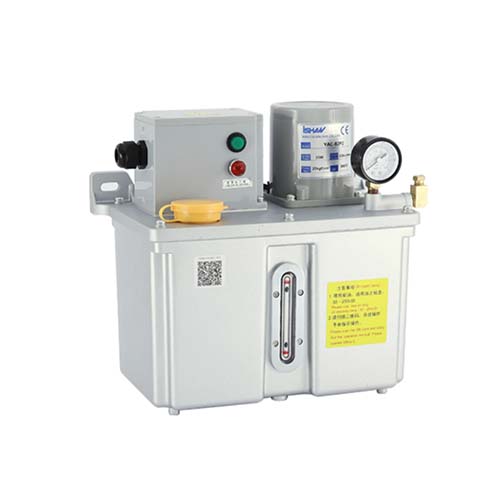
![Positive Displacement Pump System]() Positive Displacement Pump SystemOur Positive Displacement Pump System is an engineered industrial solution moving a fixed liquid volume per cycle. It forces a constant volumetric output regardless of pressure, making it the...


Types of Positive Displacement Pumps
|
Type |
Lubrication fit |
|
Piston / plunger |
Highest-pressure member of the family; ideal for high-pressure grease injection and precise oil metering in centralized systems. |
|
Gear (rotary) |
Smooth, continuous oil circulation for machine tools, gearboxes and oil-lubricated circuits. |
|
Vane |
Constant flow at varying pressure with built-in relief; good for general oil supply duties. |
|
Screw |
Highest flow of the PD types; suited to high-volume transfer of viscous lubricants. |
|
Diaphragm (AODD) |
Shear-sensitive, self-priming, inherently explosion-proof (air-driven) — for hazardous areas and delicate fluids. |
How a Positive Displacement Pump Works
Suction
The pumping chamber expands (piston/gear/diaphragm moves), creating a vacuum that draws lubricant in through the inlet.
Trapping
The fluid is captured in a sealed cavity, isolated from the inlet by a valve or tight clearance.
Displacement & discharge
The moving element reduces the chamber volume and pushes the fixed volume out the outlet at a rate set by speed and displacement — not by downstream pressure.
Why Positive Displacement — Not Centrifugal — for Lubrication
|
Capability |
Positive Displacement |
Centrifugal |
|
Flow vs. pressure |
Constant flow regardless of discharge pressure. |
Flow drops as pressure rises — bearings get less when they need it most. |
|
Viscosity |
Handles high-viscosity grease & oil. |
Struggles with thick fluids; efficiency collapses. |
|
Metering |
Precise, repeatable volume per cycle. |
Poor for accurate dosing. |
|
Self-priming |
Yes for most types. |
Generally no. |
|
Best fit |
Lubrication, metering, high-viscosity transfer. |
High-flow, low-viscosity, variable-demand service. |
Where Our PD Pump Systems Are Used
Positive displacement lubrication systems are suitable for equipment requiring controlled and repeatable lubricant delivery to multiple lubrication points.
Machine Tools: CNC machine tools, turning, milling, grinding machines, and automated machining equipment. Precise lubricant delivery helps maintain bearings, slides, guideways, and other components.
Industrial Machinery: Production machinery, packaging equipment, textile machinery, plastic processing equipment, automated production lines, and material handling equipment.
Construction Equipment: Excavators, loaders, cranes, concrete equipment, and specialty construction machinery. Centralized lubrication reduces the need for manual access to individual points.
Mobile Equipment: Off-road equipment, agricultural machinery, specialty vehicles, and mobile industrial equipment—configurable around moving components and distributed lubrication points.
Industrial Conveyors: Suitable for conveyor equipment where individual bearings or other components require controlled lubricant quantities.
Customized service
We support OEM projects with
Lubrication point mapping, injector selection, pump selection, metering configuration, manifold arrangement, piping layout, pressure monitoring, control configuration, product labeling, and technical documentation.
Information Useful for OEM Evaluation
Equipment model, lubrication point list, machine drawing, lubrication point locations, required lubricant, lubricant quantity per point, lubrication frequency, operating temperature, power supply, and existing lubrication system (if applicable).

Manufacturing Process
Material & Component Preparation: Raw materials and purchased components are checked against applicable product specifications, including material specs, dimensional requirements, surface condition, component identification, and supplier/incoming records.
Precision Machining: Critical components such as injector bodies, pistons, sleeves, and other precision parts are manufactured per technical drawings—with attention to critical dimensions, bore/piston fit, thread accuracy, surface condition, and interchangeability for consistent metering performance.
Component Cleaning: Machined components are cleaned before assembly to remove residues and contaminants that could affect internal movement or sealing—especially important for small internal passages and precision mechanisms.
Component Assembly: Components are assembled per product specifications—with attention to correct orientation, piston/sleeve installation, seal installation, spring/internal component positioning, fastener/connection condition, and assembly consistency.
Functional Testing: Finished products are checked for operating function, lubricant discharge, metering operation, pressure response, reset operation, and leakage to identify abnormalities before packing.
Final Inspection & Packaging: Before shipment, products undergo appearance check, dimensional verification, functional test, product identification, quantity check, and packaging. Inspection requirements can be adjusted for OEM/project orders per customer specifications.
Company Strength
Zhejiang Shengxiang Machinery Co., Ltd., established in 2001, is the mainland China branch of Taiwan ISHAN Precision Machinery Industry Co., Ltd. Specializing in advanced centralized lubrication systems, we offer customized design, products, and services backed by decades of expertise.
Packaging & Shipping
We provide international packaging and transportation solutions for standard products, OEM orders, and project shipments.
Packaging Options
• Export Cartons: For standard components and smaller orders
• Plywood / Wooden Cases: For heavy or fragile equipment
• Pallet Packaging: For bulk shipments and warehouse handling
• Customized Packaging: Available for OEM and distributor orders
Shipping Methods
• Sea Freight: Suitable for bulk and heavy shipments
• Air Freight: Suitable for urgent orders
• Rail Freight: Available for selected international routes

Certificates & Compliance
Certification and compliance documents can be provided according to the applicable product and project requirements.
ISO 9001:2015
CE Certification
RoHS Compliance
REACH Compliance
FAQ
As one of the most professional positive displacement system manufacturers and suppliers in China, our products have good reputation in the market. Please rest assured to buy durable positive displacement system made in China here from our factory. For price consultation, contact us.
Popular Products


