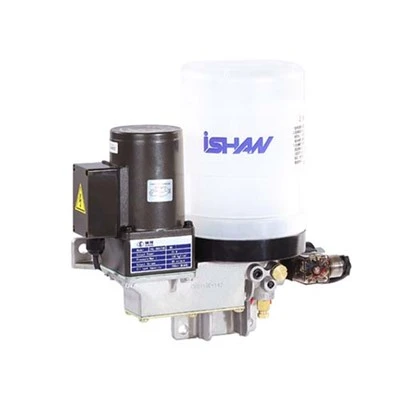
The Dual Line Lubrication System for CNC Machines is an industrial-grade, high-pressure centralized lubrication solution designed to deliver precisely metered grease or oil to multiple friction points across complex CNC machine tools, including linear motion guides, ball screws, spindle bearings, and heavy-duty slideways.
Technical Specifications
|
Parameter |
Standard Range / Specification |
|
Operating Pressure |
Up to 200 bar (20 MPa) |
|
Applicable Lubricant |
Grease (NLGI 000# – 2#) / Industrial Oil |
|
Lubrication Points |
2 to 100+ points (Modular System) |
|
Port Thread Standards |
BSPP (G1/4", G1/8"), NPT, Metric (M10×1) |
|
Power Supply |
24V DC / 220V AC / 380V AC (3-Phase) |
|
Reservoir Options |
2L / 4L / 8L / 12L (Plastic / Sheet Metal) |
|
Control Signal |
24V DC (NPN/PNP) for CNC/PLC Integration |
|
Operating Temp. |
-20°C to +80°C |
Product Features
A dual-line system operates via two main supply lines that alternately pressurize and depressurize to maintain fluid delivery across complex CNC networks:
Suitable for Large Networks: Alternating high-pressure cycles prevent line pressure drop over 30m+ pipe runs and 100+ points.
Parallel Circuit Reliability: Distributors run in parallel-a single blocked outlet will not stall or lock up the remaining lubrication points.
Positive Displacement Metering: Internal pistons output a fixed volumetric dosage per stroke, unaffected by viscosity changes or line pressure shifts.
Pressure-Triggered Fault Detection: Line changeover requires reaching preset pressure; leaks or blockages prevent changeover and trigger an immediate PLC alarm.
High-Viscosity Capability: Dual-line hydraulic force pumps thick grease (up to NLGI Grade 2) to resist cutting coolant wash-off on high-load guides and screws.
System Control & PLC Integration
Automated Cycle Control: Interfaced directly with the CNC PLC (Fanuc, Siemens, Mitsubishi, etc.) to trigger scheduled lubrication cycles based on operating hours or spindle runtime.
Closed-Loop Pressure Monitoring: Line-end pressure switches confirm that target pressure is reached across all distributors before completing a lubrication cycle.
Fault & Safety Interlocks: Integrated 24V DC signals automatically output M-code alarms or trigger machine feed-stops under abnormal conditions:
Low reservoir fluid level
Line blockage or over-pressure
Pipe leakage or pressure build-up failure
Flexible Operating Modes: Supports both automated PLC-driven cycles and manual override priming during setup or after maintenance.
Applications
Gantry & Long-Bed Mills: X/Y-axis linear guides, rack-and-pinions, and crossrails (30m+ travel).
5-Axis Machining Centers: Rotary tables, tilting trunnion axes, and spindle swivel bearings.
Vertical & Horizontal Machining Centers: X/Y/Z linear guides, ball screw nuts, and thrust bearings.
Heavy CNC Lathes & Boring Mills: Main slideways, tailstock quills, and lead screws under heavy loads.
High-Coolant Zones: Enclosed guides and screws requiring dense grease to resist coolant wash-off.
OEM Customization
A complete system can be supplied according to the machine builder's lubrication circuit and layout requirements:
Main Hardware: Electric lubrication pump, lubricant reservoir, dual-line directional valve, dual-line metering distributors.
Monitoring & Control: Pressure switches, pressure sensors, low-level sensors, control panels or interfaces.
Piping & Mounting: High-pressure lubrication tubing, tube fittings/connectors, and mounting hardware.
Circuit & Mechanical Design: Custom layout based on machine drawings, including lubrication points, pipe routing, distributor positions, and reservoir capacity matching machine size and maintenance intervals.
Electrical & Threads: Pump voltage, sensor signals, and connection standards (Metric, BSPP, NPT) matched to machine control architecture and regional standards.
OEM Supply: OEM labeling, product identification, packaging, and custom configurations for machine manufacturers.
Installation & System Integration
The dual-line lubrication system is integrated with CNC machines according to lubrication-point layout, machine cycle and available control signals.
Piping Installation: Main and branch lines are routed to bearings, guideways, ball screws and other lubrication points.
CNC Interface: Lubrication cycles can be linked to the machine PLC or control system.
Signal Integration: Pressure, low-level and pump-status signals can be connected for alarm and condition monitoring.
Commissioning: Line pressure, distributor operation and lubricant delivery are checked before operation.
Documentation: Installation drawings, piping layouts and connection information can be provided for machine integration.
Quality Control
Hydraulic Pressure & Leak Test: Pressure tested at 1.25× maximum operating pressure to verify zero seal leakage or casting internal bypass.
Distributor Displacement Verification: Individual port output accuracy is checked using fluid displacement measurement to guarantee equal metering.
Electrical & Signal Validation: Sensor output, 24V DC pressure switch response, and low-level alarms are verified for PLC signal accuracy.
Valve Cycle Inspection: Directional valves and distributor pistons undergo high-frequency switching tests to eliminate valve core sticking.
FAQ
Hot Tags: dual line lubrication system for cnc machines, China dual line lubrication system for cnc machines manufacturers, suppliers, factory